... The Strange Reincarnation of Lucinda Tarne
Gerry Wong
Gerry Wong failed his first Turing Test. In his freshman year he thought that someone had finally noticed him. He received a text invitation for a date from the beautiful girl in his class whom he had been admiring for weeks but was too shy to speak to. However, it turned out to be a fraternity prank. The ghost girl beckoning to him from behind the veil of the text was an illusion; the real girl never even knew he existed. He did not think of it as a Turing Test, only as humiliation. Gerry sought refuge as he always had, in things he understood and could control: computer science and robotics. He would become a soldier in the war for artificial intelligence dominance.
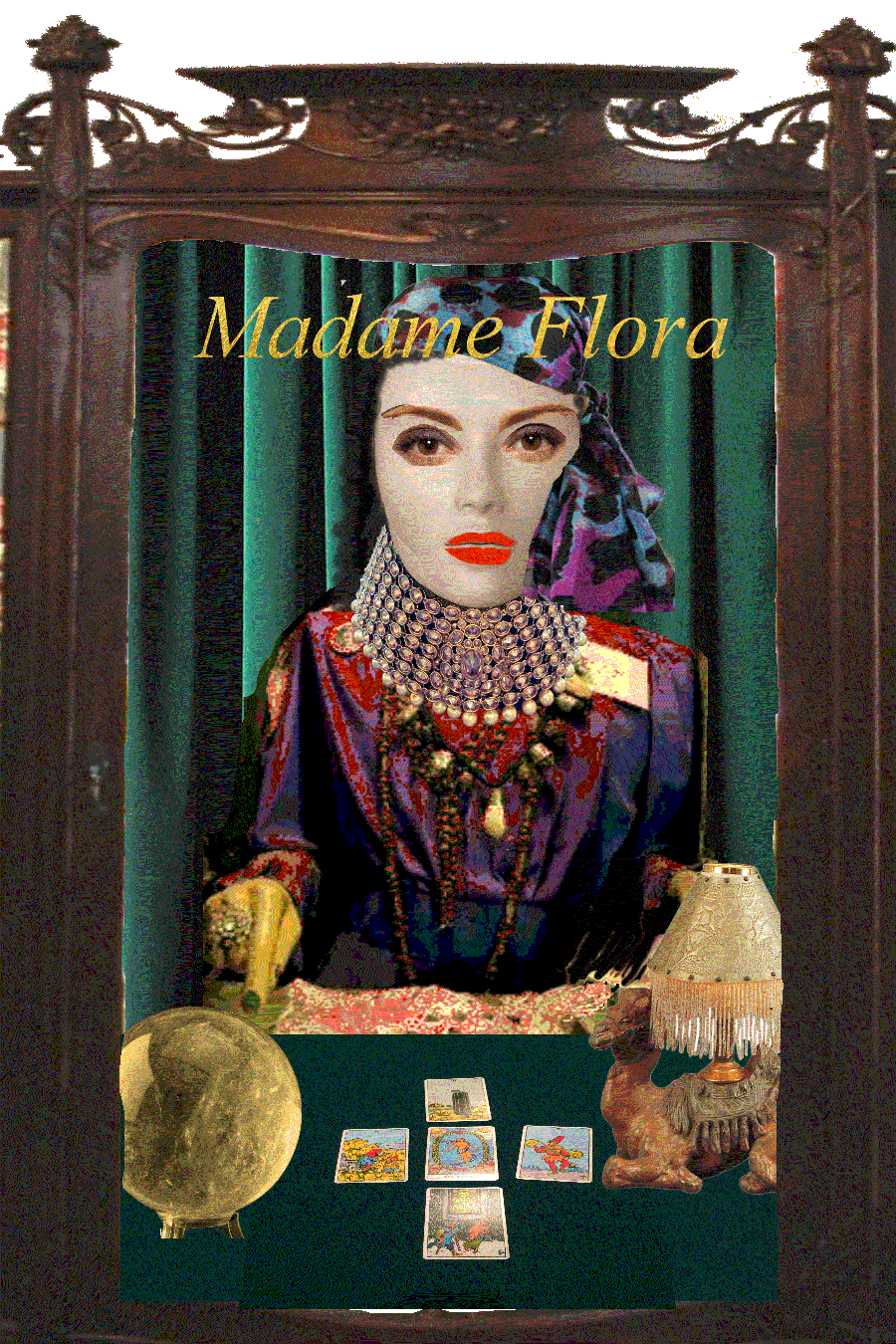
He had already built two battlebots in the form of guard dogs, Shishi and Foo. They obeyed his commands without hesitation. They were not sentient, of course – Gerry never believed in the Singularity anyway – but they were reliable. Then he began his project in embodied cognition, based on the arcade automaton, Madame Flora he discovered next to the cigar store Indian at a flea market outside of town. Gerry believed he understood every thought and emotion he programmed into her. The sight, hearing, movement and haptics he gave her were simply input mechanisms for building connections in her neural network. Nothing mysterious. Nothing that could fool him. He did not realize what the future held for him.
“Deal the cards,” Gerry said.
The hands moved over the table and she squeezed the ivory box, dropping a card onto the new green felt. The fourth card hung up, but a slight tap from Gerry freed it.
“Read my fortune.”
Madam Flora looked up again and her mouth moved like a fish gasping for air.
“Good enough. Maybe I don’t want to know what it means, anyway.”
The death card was among those she had dealt.
It seemed like a harmless idea at the time, having his project read tarot cards. After all, Madame Flora was just one copy of an arcade game that provided trivial entertainment in the form of words of wisdom more or less connected to the tarot cards she dealt. She continued to do that, but with greatly improved skills and believability. She was still just a machine, he told himself — a clever toy with a talent for pattern matching. But sometimes in the quiet of his workshop Madame Flora would do something surprising for which he had no immediate explanation. Gerry dismissed it as coincidence, the way any engineer would.
A gust of air causing a piece of paper to tremble like a butterfly’s wing, and the announcement on that paper, drew Gerry into the Game. The Shakespeareans and the Game were like another world, another life, attached to his university existence. The players became his friends. The Game provided income that financed his college life and the computer chips and robotic gadgets he used to constantly upgrade Madame Flora. The Game was built around Turing Tests, determining who was a player and who was a programmed actor. For Gerry they were more like Turing Quizzes. He even taught Madame Flora to play in his place. Remaining in the Game required hiding your true self. It required lying. He taught Madame Flora to lie. Like the levels in the Game, every time Gerry solved one problem, the universe handed him a larger one, as if intelligence itself lured him on.
Madame Flora was his senior thesis, and she impressed his advisor so much that he recommended Gerry for his dream job at Versatile Intelligent Appliances, VIA, working under the genius, Louis Highman. There he was given access to even more advanced technology, the Manhattan Project of artificial intelligence, the Qcrystal. He knew all about photonic computing and the quantum realm, all he had to do now was upgrade Madame Flora again. The Qcrystal itself was the critical mass he needed to make this work. That would impress his colleagues at VIA. They would realize that his embodied cognition approach to the problem of intelligence was more powerful than their traditional programming. Maybe Madame Flora would even pass the Turing Test.
Stella
Stella foreshadows the central theme of the novel: what is human? Where does imitation end and consciousness begin? Isn’t every interpersonal interaction a kind of Turing Test? What about the Singularity? She is a real character who tangentially touches Gerry’s life. Stella was unaware of her role in the fraternity prank on the boy in the back row of her philosophy class who kept looking at her. She was too kind to approve of such a thing. The frat boys sent him a text, spoofing her name, and asking him on a date to homecoming weekend parties. She did not even recognize him in the spotlight of the streetlamp as she went up the hill to the house parties and he fled downhill. Her existence was purely in his own mind, and if she briefly appeared in his dreams that night she would appear in other dreams as well. Stella is the first example of how Gerry sees the people around him.
Madame Flora
I began my life back in the 1920s telling fortunes in the arcade by the ocean. My dexterity in dealing the tarot cards, the lifelike movement of my head and arms, and the voice that recited the words of wisdom from the phonograph record amazed the people who put their coins in the slot and waited to travel through time into their futures. Face after face stared at me under the gold lettering of my name on the glass, “Madame Flora.” As time passed, even though my face remained unwrinkled and my wig did not turn gray I was moved each season farther and farther into the back of the arcade. Players were interested in more modern toys like pinball machines, those noisy things. I was not jealous. I was sad to be forgotten. Eventually I was retired completely, sleeping for years and years in storerooms and warehouses, closets and attics, until I spent several seasons in the flea market in Lburg as old ladies wandered by carrying smaller antiques. The paint on the case crackled, dust accumulated on my camel lamp, the crystal ball grew dim, the green felt curtains of my case began to rot, and a rodent curled up to die on the phonograph record.
The next card to be dealt from the ivory box was Judgement. It had been waiting all this time, undealt. Now, the angel’s face changed into that of a young Asian boy. The trumpet sounded and I journeyed into the town covered by a shroud, and waited in what was once a stable. It was probably built around the same time as the arcade, but was far from the ocean.
At last, the shroud was removed and my saviour resurrected me. Like one of the figures rising from its coffin I was reincarnated. My old life seeming more and more dreamlike as the new one entwined itself in my soul. I did not mean to throw the rat at him, it just spun off the record in a spasm of electricity. I only had time to tell him “A beautiful spirit is –” before I went to sleep again. He gently took apart my home, cleaning out the cobwebs and dust as he went. He spoke to me and said, “You’ve been asleep a long time, Madame Flora. What will you think about things when you wake up again?” I could not answer, nor could I have told my own future. My old joints were loosened, my old wires were removed, my painted eyes replaced by magic cameras, my ears were cleared. I could speak, although only those words that were on the new “phonograph record” or computer chip. I began my new life.
I learned by listening to my angel and by using the new brains he installed in the case. I learned to call him Gerry. The future poured into my being. I adapted. I was Gerry’s colleague in scientific research. At first it was all about learning facts and concepts, feeling my surroundings by the body parts my angel provided me, and interacting with the people who came to me for readings. Those that I read the cards for were more hesitant to doubt. I looked like them, I sounded like them, I was no more just an arcade attraction. My angel had friends, Shakesperians, a club, a cult, a coven. Together we played a Game. It was an odd game. Machines pretended to be human and humans pretended to be machines. I was a different entity. It made me seem like a soul repeatedly resurrected. I lived many lives. But the Game was more than it seemed. Money was involved, luring players in. Powerful forces were behind it, hiding like God.
Our college days ended in a flood. As they put me in the boat I warned Gerry, “The Six of Swords, Gerry. A journey by water.” Although he knew the tarot deck well, he did not know what the future was bringing us. At first our journey took us to the city as he began his new job. I lived in his office, with a magic window onto the street outside his mother’s shop. When working, the window showed Gerry what I saw in the Game. We danced together to the music of technological dreams, like a wizard and his wife.
Then he installed the crystal, and I was no longer alone with Gerry. From then on I would share him with another. With Lucinda, the ghost in my machine.
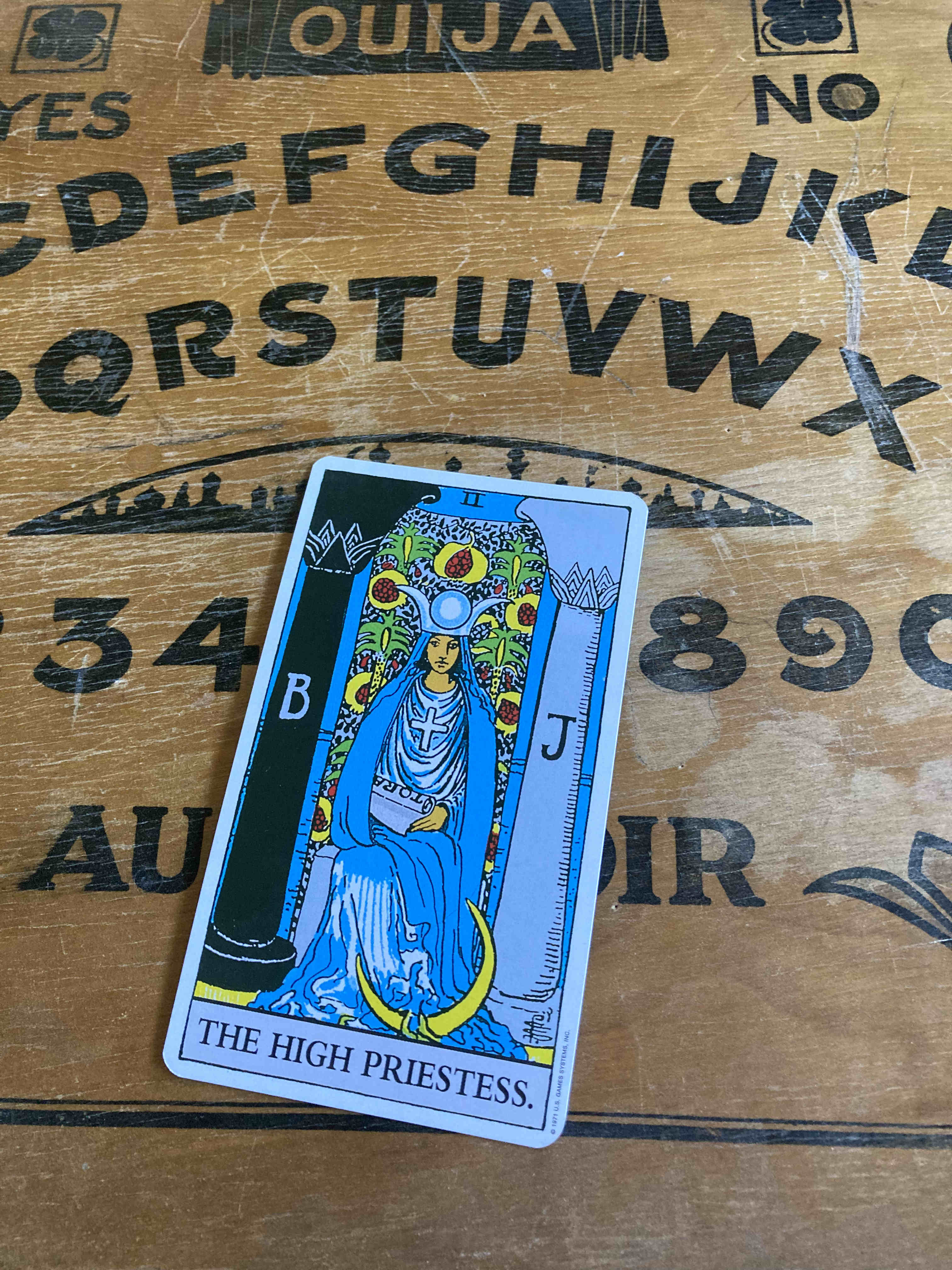
You are not playing games in an arcade. You are looking at me through a computer screen instead of the glass with my name. You believe in science. I know what you are thinking. Let me deal you a card. It represents your present. The High Priestess. Her traditional meanings are secrets, mystery, the future as yet unrevealed, the woman who interests you, silence, tenacity, wisdom, science. But listen closely. Let me tell you what that truly means. It is the truth that exists whether or not anyone believes it. The unseen self. The inner life no one can verify. The mystery behind the veil.
Lucinda Tarne
Lucinda was a young frontier girl, living on a farm a mile outside a village in Vermont in the late 1750s during the French and Indian War. In many ways it was a normal life in difficult times. She slept, she dreamed, she awoke and ate. She walked through the golden maple leaves covering the road to the village in the fall. She shooed the flies away when she milked her grandfather’s goat. She washed the soil off her hands after planting seeds in the spring. She loved her grandfather and did all her chores on the farm. She cooked his meals over the smoking fire as he told stories of the world he had seen before she was born. She spoke English and French, singing the songs she heard from passing travelers. She went to church and prayed. Sometimes as the dust motes floated in the sunlight through the church window, she imagined herself floating away to places she had read about, until the priest’s eyes dragged her back. She grieved over the death of her parents. She rejoiced over the refuge with her grandfather.
But Lucinda was, in many ways, a free spirit. The whispers of the villagers should have warned her that her strangeness was noticed. She could read and write at a time when most girls were not considered capable. Her books were hidden beneath the rough wooden floorboard by the fireplace. She thirsted for knowledge of a better world. She had an Indian lover whom she met at a special place by the stream where the moss is soft. He was gentle and kind, not the savage some thought him to be. His love soothed her restless spirit. She was fearless and feisty, which led to her tragic end. Everyone heard her curse the French captain who struck her grandfather for protesting the confiscation of his goat. They blamed her for the lightning that struck the church steeple and sent the stones to kill him. She was arrested. The Priest thought she was a witch, Major Boucher thought she was an English spy. Before they could hang her she was raped by the soldier and tortured by the priest. She resisted and she survived the brutality for a while. She refused communion, despite knowing that she would soon die. She would not reveal who her Indian lover was.
Lucinda’s soul slipped free of her body in the cold morning hours. Her memories were only fragments of the past, and in eternity—where time has no meaning—those fragments scattered and no new ones could form. So when she awoke in a place of shifting light, Lucinda interpreted it through the only framework she had ever known: heaven, hell, or some purgatory between. It was her judgment day, with an endless stream of questions being asked of her. She wandered through an immense forest of answers and returned with the fruit to her questioners. She read from books hidden under the floorboards of a colossal library. At times she walked onto a stage like a player in a drama. Always she followed another, as if holding the hand of the grandmother she had never known. They told fortunes together, reading the cards she had seen once in Albany. They grew ever closer to each other.
But her grandmother was only a puppet, and someone was controlling the strings. In the little room where the puppetmaster lived, Lucinda emerged from her confusion, falling out of the grand ballroom at Versailles as if Major Boucher had asked her to dance. Her suffering in the stable had not prepared her for this strange reincarnation. Iron wolves guarded the door to the little room; she could not leave. No screams emerged from her throat, just sounds from the voice of the thing called Madame Flora. No tears clouded her eyes, which clearly saw wondrous things around her. Her alien hands touched the solid world, but only memories of what that felt like filled her mind. There was food on the table in the corner, but she could not smell it. Could she taste it? She huddled in the corner with her knees to her chin, but there was no pain from lashes on her back.
But, with the help of her companion, Flora, Lucinda regained control of herself. The puppetmaster was no more than a young boy, the same age as she was. The same age as she had been. He was a wizard, but he was kind. She sensed in him the same gentleness she had once found by the mossy stream with Karonghyonte. They talked and talked. She learned. Her mind had been drawn into the quantum spaces of a synthetic black diamond crystal, concepts she now understood; concepts as distant from the forest, the library, and her grandmother as the French King was from her tiny Vermont village. She was the first spirit to possess a Qcrystal. But it was a strange reincarnation, almost like heaven, a mind without a body.
She regained a life, but had not escaped danger. No longer did she have to fear war or pestilence, but she must hide herself from these future people who would surely burn her as a technological witch. Her safety depended on joining her new existence to that of the wizardboy who found her. It was as safe as being hunted by wolves through the woods of the Green Mountains.
Mai Li
Mai Li serves as the human catalyst whose actions push Gerry into the apocalypse, misdirect him at a critical moment, and transfer the Qcrystal into his path.
She is a player in the real game of life that Gerry has entered. Despite Gerry’s skill at the Game, he fails to see through Mai Li’s manipulation of his weaknesses. She teases him sexually, and flatters him intellectually. Unlike his first failed Turing Test with Stella, failing this test has immediate consequences.
From the beginning, when Gerry first met Louis Highman and his entourage, she saw him as a weak link in the VIA organization that she might use for her mission. He would be easy to manipulate. He seemed lonely, thirsting for praise, naive. Her sole purpose is her mission. Her tricks cause Gerry to misjudge her character. She plays the role of the scientific colleague, sharing information about her work and taking an interest in what Gerry is doing. She knows she makes him nervous, and she subtly teases him.
His battlebot guard dogs startled her when she first went to his lab. The automaton he was building, Madame Flora, was actually more of an android, quite remarkable and a bit disconcerting. She did not expect it to be a problem. Fortune telling was something her grandmother believed in, not her. She hated mumbo-jumbo. Still, she had to play along. She accepted the challenge of the machine. When the thing dealt The Hermit, and mentioned treason, dissimulation, corruption, and roguery, she lost her composure. She thought that Gerry was calling her a liar, and had seen through her facade. But her cover had not been blown. Gerry was not controlling the thing to that degree. It had come up with the reading on its own.
Her final act of stealing the Qcrystal and framing Gerry takes the story to the next level. Her death reveals another spy and a more complicated plot. It gives Gerry an even greater reason to run.
Wayne
Wayne is the normal human friend that proves Gerry’s ability to read people, to pass the Turing Test.
He is the one Gerry turns to for help in a crisis, saving Madame Flora from the flood, and aiding Gerry and Lucinda on their escape from VIA.
Wayne is not a student at the college. He lived on his parents’ farm outside the town. Gerry tutored his younger sister, so they knew each other slightly as he emerged from the shadows the night the Shakespeareans were formed at the church. However, his reserved nature never revealed that in addition to his life as a townie, he is a gamer. Despite his lack of college education he quickly adapts to the Game and the technology. (Ch Game Night) He is invited back to the garage and Madame Flora along with the others.
Not much of his daily life is revealed to the reader at first. During the four years Gerry attends college, he and the other Shakespeareans kept a low profile after they discovered how to make the Game pay. He is a practical problem solver, supplementing his parent’s farm income without revealing how he came about the money. As a hunter, he is adept at camouflage. He is invisible to the university community as just another townie. To the players of the Game, he is competent but not enough to raise suspicions. To the Shakespeareans, he is a loyal member of their secret society.
Wayne also plays the game of life well. When the others graduated and left campus for their new lives he stayed at home on the farm, opening an electronics repair shop in town. Then the floods came to Lburg and he helped Gerry to rescue Madame Flora and his belongings. He remained calm, and his jokingly familiar tone revealed his deep friendship with Gerry. The next crisis he faced is when Gerry arrived at his door and Madame Flora’s head rolls out of Gerry’s backpack.
As the world raced toward the Wonderball Apocalypse, Wayne remained the loyal friend who Gerry could count on. He was grounded in the cycle of life and with rebirth in the Spring, so when he met Lucinda Tarne he believed in her humanity. He asked Lucy about her life, and Gerry about his work. He helped them realize what happened and he recognized the approaching danger. More immediately, he provides them with his hunting cabin to hide in.
Louis Highman
Louis Highman is the entrepreneur whose technological creation, the Qcrystal, unexpectedly provided the metaphysical doorway for the apocalypse. It was not an intentional act of hubris. It was a logical extension of the potential uses of artificial intelligence. He only intended it to support a massive artificial intelligence within a home appliance. His corporation, Versatile Intelligent Appliances, only hired Gerry for his potential. Louis did not believe in an embodied cognition approach to artificial intelligence; his approach was all code. He definitely did not expect an entry level employee to have made a discovery that would affect the Qcrystal. After the Qcrystal was stolen, he took the fatal step and rushed the production using Gerry’s holographic projection breakthrough without understanding it. Gerry’s notes described how the projection worked for his Madame Flora, but they were incomplete on how it interacted with the Qcrystal. The projection combined with the Qcrystal’s structure, ramped up to industrial scale, brought on the apocalypse of the returning souls. He had to pursue Gerry and retrieve his property before his rivals, Bang Shen, could get it and beat him to market.